Yunge Wen
M.S. Computer Science @New York University
Research Intern at Multisensory Intelligence @MIT Media Lab
Computer Graphics | AI for Games and Creativity | Human Computer Interaction
yungew@mit.edu
LinkedIn | Github | Google Scholar | Bilibili
NEWS
[Oct 2026] Gave an invited talk at Tongji University: "From Generated Results to the Creative Process: Controllable Generation Systems for Professional Users"
[Oct 2026] Invited to serve as a reviewer for CHI 2027!
RESEARCH IN PROGRESS
GRAPHICS & CREATIVITY
🎨PaintCopilot: Modeling Painting as Autonomous Artistic Continuation
Yunge Wen, Yaluo Wang, Yuancheng Shen, Robert Krueger, Paul Pu Liang
Neurips 2026 Creative AI Track | paper | video | live demo!
We present PaintCopilot, a co-creative neural painting assistant built on differentiable brush representations (SVG Brush Tip and 2D Gaussian), integrating three lightweight AI models: a ViT-based Target Predictor, an autoregressive Next Stroke Predictor via flow matching, and a VAE-based Region Sampler, enabling artists and AI to continuously alternate control throughout the creative process.
Text-Driven Artistic Staging: 3D Posing, Lighting, and Camera References from Paintings
Yunge Wen
SIGGRAPH Asia 2026 Poster (Full Paper Under Review) | paper | video | live demo!
We introduce text-to-editable 3D staging, jointly generating human poses, dominant lighting, and camera placement from affective text. Using 11,911 text–staging pairs reconstructed from 2,328 figurative paintings, we train a flow-matching transformer that handles multiple figures and produces diverse staging alternatives.
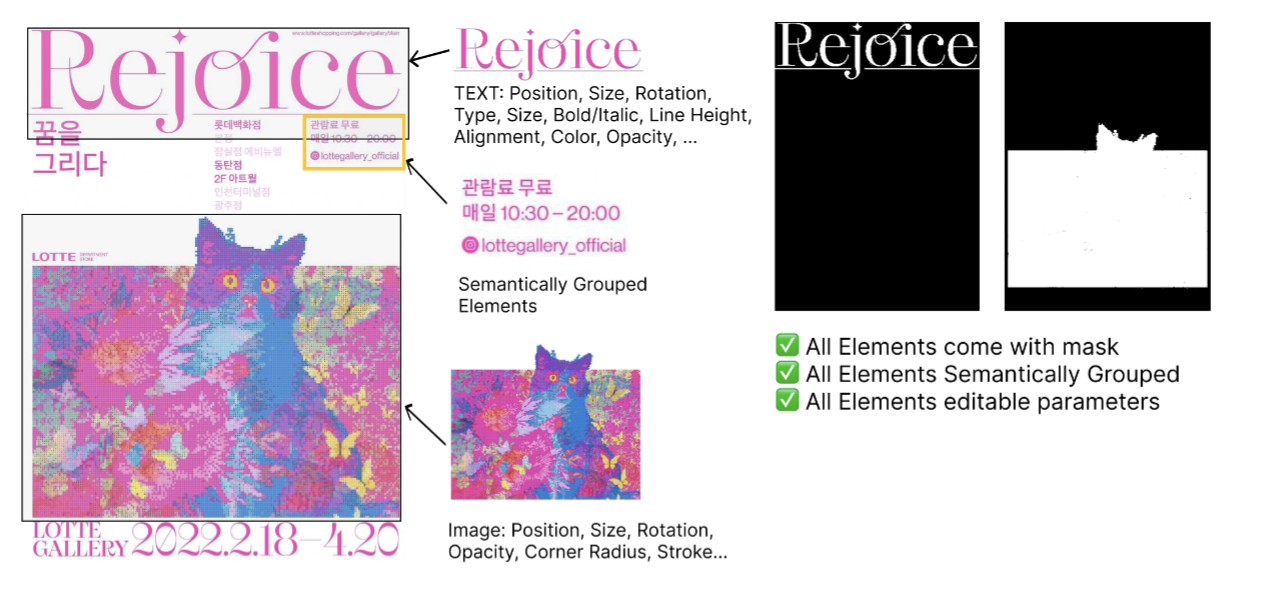
LayerParse: Parsing Graphic Design Images into Editable Layer with VLM
Yunge Wen, Bob Tianqi Wei
Manuscript In Preparation | proposal
We present LayerParse, a vision-language model that parses raster graphic design images into structured editable layer representations by jointly predicting a typed element tree, per-element segmentation masks, and continuous 36-dimensional attribute vectors through a novel AttrHead that avoids token quantization error, trained entirely on a procedurally generated synthetic dataset with exact ground truth at zero labeling cost.
Narrative Arc-Conditioned Gameplay Planning
Yunge Wen, Chenliang Huang, Hangyu Zhou, Zhuo Zeng, Yuxuan Weng, Timothy Merino, Julian Togelius, Max Kreminsky, Sam Earle
CHI 2026 Poster (Full Paper Under Review) | paper | video | live demo!
We propose Forking Garden, a framework for planning branching games via narrative archetypes (e.g., Hero's Journey). Independent nodes are assembled into a dungeon graph through arc-guided constraints, achieving multimodal alignment of gameplay elements. We demonstrate an end-to-end interactive system instantiating this framework.

DuoZone: A User-Centric, LLM-Guided Mixed-Initiative XR Window Management System
Jing Qian*, George X. Wang*, Xiangyu Li, Yunge Wen, Guande Wu, Sonia Castelo Quispe, Fumeng Yang, Claudio Silva.
TVCG 2026; ISMAR 2026 | paper
We propose DuoZone, a mixed-initiative human–AI window management system in Extended Reality (XR) that enhances functionality for placing, arranging, and resizing virtual windows, preserving user agency while automating window management via user-created spatial zones and LLM-generated hints for multi-scenario efficiency, demonstrated on Apple Vision Pro.
SyncSpace: Layout-Conditioned 3D Gaussian Splatting for Space Reskinning in Mixed Reality
Qinchuan Zhang, Weibo Xu, Yunge Wen
Under Review | paper | video
We present SyncSpace, a system aligning generated 3DGS worlds with physical spaces while maintaining visual consistency. Depth-derived layouts guide a generative world model to reskin spaces while preserving geometry. Coarse-to-fine registration aligns generated and physical scenes. We demonstrate hand-tracked world engulfment and multiple stylistic transformations of the same physical space.
AI OLFACTION
SMELLNET: A Large-scale Dataset for Real-world Smell Recognition
Dewei Feng, Carol Li, Wei Dai, Alistair Pernigo, Yunge Wen, Paul Pu Liang
ICLR 2026 | paper | code | video
We present SmellNet, a large sensor-based olfaction dataset with 828K time-series points across 50 substances (nuts, spices, herbs, fruits, vegetables) and 43 mixtures, totaling 68 hours of data. Using it, we developed ScentFormer, a Transformer model with temporal differencing and sliding-window augmentation, targeting applications in allergen detection, process monitoring, and emotion/disease sensing.
AromaGen: Interactive Generation of Rich Olfactory Experiences with Multimodal LLM
Yunge Wen*, Awu Chen*, Jianing Yu*, Jas Brooks, Hiroshi Ishii, Paul Pu Liang
CVPR Workshop 2026 (Outstanding Paper Award) (Full Paper Under Review) | paper | video
We present AromaGen, an AI-powered wearable interface capable of real-time, general-purpose aroma generation from free-form text or visual inputs. AromaGen is powered by a multimodal LLM that leverages latent olfactory knowledge to map semantic inputs to structured mixtures of 12 carefully selected base odorants, released through a neck-worn dispenser. Users can iteratively refine generated aromas through natural language feedback via in-context learning.
Smell with Genji: Rediscovering Human Perception through an Olfactory Game with AI
Awu Chen, Vera Yu Wu, Yunge Wen, Yaluo Wang, Jiaxuan Olivia Yin, Yichen Wang, Qian Xiang, Richard Zhang, Paul Pu Liang, and Hiroshi Ishii
CHI Poster & Interactive Demo 2026 | poster | video
Genji-kō (源氏香) is a traditional Japanese incense game that structures olfactory experience through comparison, memory, and collective sensing. We reinterpret this ritual as Smell with Genji, a human–AI collaborative system integrating an olfactory sensor and smell AI described in SmellNet, a mobile application, and an AI co-smelling large language model.
MULTIMODAL INTERACTION
Whispering Water: Materializing Human-AI Dialogue as Interactive Ripples
Ruipeng Wang*, Tawab Safi*, Yunge Wen*, Christina Cunningham, Hoi Ling Tang, and Behnaz Farahi
SIGGRAPH Asia 2026 Art Paper, IEEE VIS 2026 Art Gallery | paper | video
Whispering Water is an interactive installation that materializes human–AI dialogue through cymatic patterns on water. We propose a novel algorithm that decomposes speech into component waves and reconstructs them in water, establishing a translation between linguistic expression and the physics of material form.
NephoCodex: Exploring Bounded Material Agency in Weather Data Physicalization
Yuxuan Weng, Yunge Wen
Under Review | paper
We present NephoCodex, a weather data physicalization system that distinguishes computational uncertainty from material variability through bounded material agency. Probability-weighted mappings and entropy-based regulation control mist, airflow, light, and displays. A user study found increased spatial presence and physical demand, while data comprehensibility remained inconclusive, informing hybrid physicalization design.
InsectSync 2.0: A Biomimetic Insect-Structured Installation for Experiencing Non-Human Respiratory Rhythms
Yuxuan Weng, Yunge Wen
UBICOMP 2026 IMWUT Design Exhibition | paper
InsectSync 2.0 explores cross-species respiratory synchronization by translating the desert locust's Discontinuous Gas Exchange Cycle onto human breathing. Through graduated diaphragmatic constraint and a first-person locust visual narrative driven by real-time respiratory state, participants voluntarily relinquish respiratory autonomy, reconsidering physiological kinship with an organism conventionally framed as a pest.
Semantic Zooming Interface for Fruitfly Brain Connectome
Jizheng Dong, Yuancheng Shen, Yunge Wen, Yu Cheng, Emma Obermiller, Erdem Varol, Robert Krueger
Manuscript In Preparation | video
We present an interactive visualization tool for the FlyWire dataset that integrates morphological clustering and single-neuron downsampling with multi-resolution rendering and semantic zooming, enabling intuitive, Google Maps-style exploration and significantly reducing visual clutter for large-scale neuronal networks.
AVA-Align: Generating Rubric-Aligned Feedback from Long Classroom Videos
Ao Qu*,Yuxi Wen*, Jiayi Zhang*, Yunge Wen, Yibo Zhao, Alok Prakash, Andrés F. Salazar-Gómez, Paul Pu Liang, Jinhua Zhao
Under Review | paper | video
We propose AVA-Align (Adaptive Video Agent with Alignment), a video–language model framework that addresses long-context understanding, temporal precision, and instruction following for classroom settings, generating rubric-aligned feedback from long classroom recordings to enhance teacher performance.

"See What I Imagine, Imagine What I See": Human-AI Co-Creation System for 360° Panoramic Video Generation in VR
Yunge Wen | paper
We introduce Imagine360, a proof-of-concept VR system integrating co-creation principles with AI agents for panoramic video generation, enabling users to generate, evaluate, and refine immersive environments in real time through speech-based prompts and egocentric focal point recentering.
PROJECTS

Bayesian Motion Trajectory Prediction
Finetuned YOLOv8 with the VisDrone dataset to enhance small object tracking, using Kalman filters to track single and multiple objects and predict their motion trajectories.
[Github]

Neural Style Transfer
Reproduced the 2015 seminal paper on image style transfer, with step-by-step visualization of content and style convolution results.
[Github]

Video2Video Search
Trained a convolutional autoencoder on Coco dataset. Extracted feature maps from video screenshots, stored in a vector database, and compared with query images through vector similarity.
[Github]

Enhancing LLM Accuracy with RAG
Created Huggingface WebApp to demonstrate retrieval-augmented generation for non-technical corporate users.
COMPUTATIONAL DESIGN


